
• Workshop: From Archives to Ethnographies (extended deadline until 7 January 2026)

    Workshop: From Archives to Ethnographies (extended deadline until 7 January 2026)

    Studying Experiences, Imaginaries and Legacies of Conflict, War and Violence across the Social Sciences and the Humanities

    Thursday 5 February 2026, 09:30-17:00 at the Vondelzaal, UB (University of Amsterdam)*

    This interdisciplinary workshop brings together scholars at all career stages (including PhD researchers) from both the Social Sciences and the Humanities who study conflict, war, and violence at the UvA. Despite clear societal relevance, shared research interests, and overlapping research experiences, disciplinary and institutional boundaries continue to hinder interdisciplinary understanding and cooperation. This is especially visible in the practicalities of conducting research on these topics.

    In this workshop, we aim to explore points of connection as well as tensions by focusing on four interrelated themes. These will serve as the basis for roundtable discussions that elicit and address struggles around:

    1. Methods: What epistemologies guide our work? Which methods do we employ to study conflict, war, and violence? What counts as data, and how do we analyze it? How do these choices shape our work both in and beyond the field?
    2. Ethics: Which ethical dilemmas arise when studying conflict, war, and violence? What responsibilities do we have toward our research participants and toward archival material? How do we navigate the “politics of ethics”? And how do we reconcile our ethical research practice with requirements imposed by ethics committees?
    3. Care practices: How do we deal with the emotional and mental toll of researching conflict, war, and violence, whether through engagement with visual or textual material or through interaction with survivors? What forms of support do we need, and which do we actually receive? How, if at all, do our institutions acknowledge this emotional burden?
    4. Engagement and activism: Can and should we use our work to contribute to political or societal change, and if so, how? With whom do we collaborate? What is the societal relevance of our research, and how do politics or society respond to the critiques we may put forward, for example in the context of militarization or rising authoritarianism in Europe? How do we deal with situations in which our work becomes politicized or marginalized?

    Across four collaborative roundtable sessions, we invite scholars from different disciplinary backgrounds to speak briefly on one of these themes from their own experiences, followed by interdisciplinary discussion and debate. The main aim is to build mutual understanding of each other’s research practices, foster collaboration, inspire new ideas, and lay groundwork for future cross-disciplinary and cross-faculty initiatives.

    Please submit your expression of interest in presenting by by the extended deadline of Wednesday 7 January using the link below. We will follow up and compose the program by mid-January. We very much look forward to hearing from you.

    If you have any questions, don’t hesitate to reach out to Julienne at j.h.j.weegels@uva.nl 

    Sign up here

    This workshop is organized by Samuël Kruizinga, Hanna Mühlenhoff, and Julienne Weegels with the support of the ARTES research cluster Social Justice & Contestation, the research group Conflict, War & Violence, the Amsterdam Centre for Conflict Studies (ACCS), and the Conflict & Society RPA.

  • Call: UvA Researchers working on Conflict and Violence who could use a student research assistant

    RPA Conflict and Society Sudent Fellowships – Call for conflict researchers looking for research assistants for the third round of the fellowship programme (starting February 2026)

    Could you use a bachelor-level student assistant for your research on conflict and violence? The Research Priority Area (RPA) Conflict and Society facilitates bachelor’s student research assistance on projects of FMG researchers. We offer fellowships of €1,000 per year per bachelor student research assistant, which corresponds to about 53 hours of work (€19 per hour) per student.

    ‘The RPA’s aim with the Student Fellowships is to bring students from all backgrounds into contact with academic research. To that end, we prefer to advertise positions to students through an open call and actively prioritise applicants from underrepresented groups in science/research, such as first-generation-university students and students from minority backgrounds.’

    Interested?

    Please send us a short project description (around 100–150 words). Please highlight the tasks of the research assistant and any requirements for the RA. If applicable, you may also include a short statement on ethics.

    The Student Fellowships are open to all bachelor students from the FMG, 2nd year and up. Project leaders decide whom to hire.

    Apply before January 12th 2026, by sending an email to: edu-rpa-conflictsociety-fmg@uva.nl.

    If you have any questions, do not hesitate to reach out. 

  • Call: Seed Grants Datafied Warfare and Societal Resilience

    Responsible Digital Transformations (RDT) is pleased to announce a new call for Seed Grant proposals, with a thematic focus on Datafied Warfare & Societal Resilience.

    Contemporary warfare and security practices are significantly shaped by digitisation and Artificial Intelligence (AI), with all aspects of conflict becoming increasingly data-driven. Data analytics and AI are crucial in modern conflicts for information gathering, military strategy, automated targeting, and battlefield simulation, enhancing precision, speed, and autonomy of warfare systems. Big Tech companies and governments are playing significant roles in data-driven battlefield targeting and experimentation, potentially signalling a new regime of warfare.

    These developments raise profound and urgent legal, societal, behavioural, ethical, cultural, economic, ecological and health questions that cut across all disciplines and faculties at the UvA. 

    RDT therefore invites seed grant proposals that map, understand, and analyse these developments from an interdisciplinary perspective, with a core focus on questions of digital responsibility. Collaborations can combine technical and non-technical disciplines – for example, between computer scientists, ethicists, legal scholars, and social scientists. The totality of different proposals will contribute to developing societal resilience around datafied warfare.

    Submit your proposal before 15 February 2026.
    Find the Seed Grant Call on the RDT website  →Register for the information sessionJoin us for an information session on 15 January 2026, 9:00-11:00.

    This session is open to all UvA colleagues who are curious to learn more about the topic and the call. It is also a great opportunity to meet other interested colleagues. We look forward to your participation. Register by 6 January 2026  →

  • Talk: Peace Agreements, Public Opinion, and Democracy: Lessons from the Colombian Case

    Talk: Peace Agreements, Public Opinion, and Democracy: Lessons from the Colombian Case

    Lunch talk by Prof. Miguel García-Sánchez, hosted by the Amsterdam Centre for Conflict Studies (ACCS) and the RPA Conflict and Society

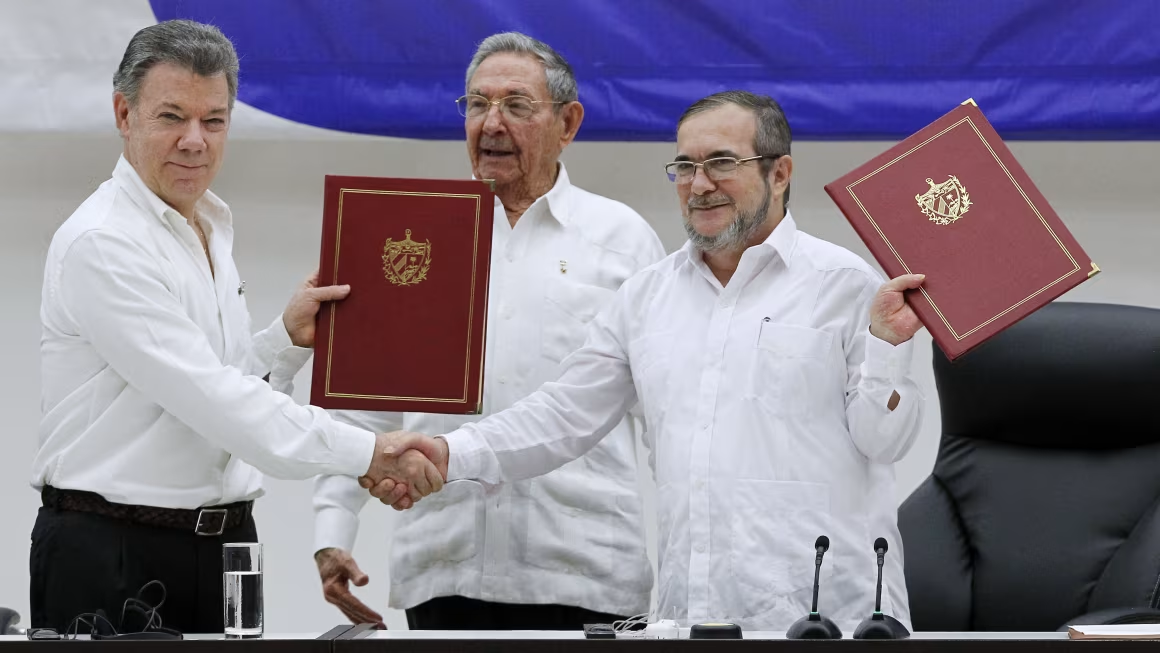
    In this lunch talk, on Demcember 12th, Prof. Miguel García-Sánchez will examine the intricate relationship between public opinion and the 2016 peace agreement, drawing on more than one decade of research on peace-related issues.

    The presentation will highlight how citizen attitudes toward peace are complex, multidimensional, evolve over time, and are shaped by elite discourse, political polarization, and expectations of future benefits derived from the agreement. Prof. García-Sánchez analyzes the 2016 Havana Peace Accord not merely as a conflict resolution mechanism but as a multidimensional public policy framework aimed at addressing structural democratic deficits.

    Findings reveal that public support for negotiated solutions to armed conflict coexists with resistance to components related to democratic inclusivity and transitional justice. Similarly, it is shown that political elites and future expectations about the agreement (rather than experiences of violence) played a pivotal role in shaping public opinion toward the peace process.

    In sum, the Colombian case offers broader insights into other peace agreements and into how public opinion interacts with major policy debates. It underscores the importance of understanding multidimensional citizen perspectives, the strategic simplification of complex issues by political actors, and the challenges posed by inclusivity in contemporary democracies. These findings contribute to comparative discussions on peacebuilding, democratic resilience, and the role of political elites in shaping public opinion.

    Hosted by the Amsterdam Centre for Conflict Studies (ACCS) and the RPA Conflict and Society.

    About the speaker

    Miguel García-Sánchez is a Professor of Political Science and Global Studies at Universidad de los Andes (Colombia) and Co-Director of the Observatorio de la Democracia at the same institution. He earned his Ph.D. in Political Science from the University of Pittsburgh. His research focuses on public opinion, particularly how social and political contexts shape citizens’ attitudes and behaviors. His most recent work bridges political behavior and peace and conflict studies to understand how citizens form opinions about peace agreements. Through the Observatorio de la Democracia, he has led multiple consultancies on topics such as police reform and the impact of local development programs linked to Colombia’s 2016 peace agreement.

    He is a member of the Colombia Working Group at the Folke Bernadotte Academy and the Citizens in Peace Processes research network and serves on the Executive Committee of the Latin American Peace Science Society. His work has appeared in journals such as The Journal of Politics, Journal of Conflict Resolution, Journal of Peace Research, International Journal of Public Opinion Research, Journal of Development Studies, Latin American Politics and Society, Política y Gobierno, and Revista de Ciencia Política.

    Conflict & Society Research Priority Area (RPA) University of Amsterdam (UvA)
    Miguel García-Sánchez
  • Workshop: Unpacking Academic Writing: From Research to Publication

    Workshop with Dr. Sebastian van Baalen, hosted by ACCS and the RPA Conflict and Society

    Join us for this writing workshop with Sebastian van Baalen, Associate Professor at the Department of Peace and Conflict Research at Uppsala University in Sweden. This workshop will offer a practical guide to moving from research to published article, taking participants step-by-step through the writing, submission, revision, and proof stages of the publication process.

    Drawing on more than a decade of professional writing experience and extensive insights from publishing, peer-reviewing, and supervising, the workshop demystifies common hurdles and provides concrete, actionable strategies for improving your academic writing and better selling your research. The aim of the workshop is that participants will leave with a clearer sense of how to craft a strong publishable manuscript, respond effectively to editors and reviewers, and manage the often opaque journey from first draft to final publication.

    This workshop is hosted by the Amsterdam Centre for Conflict Studies (ACCS) and the RPA Conflict and Society.

    About the speaker

    Dr. Sebastian van Baalen.

    Sebastian van Baalen is Associate Professor at the Department of Peace and Conflict Research at Uppsala University in Sweden. His research focuses on civilian agency and resistance in contexts characterized by violence and authoritarianism. He is currently leading a three-year research project on the consequences of election boycotts. Sebastian’s research has been published in a range of high-ranking academic journals, including American Political Science Review, Comparative Political Studies, Journal of Peace Research, Political Geography, and World Development. He has a background as a freelance journalist, and still considers writing the most exciting of his daily tasks.

  • News: Student Fellowships 2025-26 Officially Started

    News: Student Fellowships 2025-26 Officially Started

    Last week, the RPA Conflict & Society officially kicked off the Student Fellowships for the first semester of this year. 12 student fellows work on 10 projects, ranging from issues such as violence against children, intergenerational mental health, global conflicts that receive little media attention, experiences of microaggressions, the digitalisation of drug markets, cannabis supply modes, and Black Studies. They use different approaches, from experiments and surveys to fieldwork, data analysis, and systematic reviews. 

    A warm welcome to all student fellows! All projects can be found here.

    For the second semester, new positions on new projects will open near the end of this semester.

    RPA Conflict & Society (University of Amsterdam, UvA). Student Fellowship Semester 1 2025-26 Kick-off meeting
    RPA Conflict & Society (University of Amsterdam, UvA). Student Fellowship Semester 1 2025-26 Kick-off meeting
    RPA Conflict & Society (University of Amsterdam, UvA). Student Fellowship Semester 1 2025-26 Kick-off meeting
  • Closed: Bachelor Student Fellowships Conflict & Violence Projects (Semester 1 2025-26)

    Closed: Bachelor Student Fellowships Conflict & Violence Projects (Semester 1 2025-26)

    The applications for the Student Fellowships in Semester 1 2025-26 are now closed

    New Fellowships for the 2nd Semster will open later this year

    Are you interested in conflict or violence, and in research? Become a research assistant on a conflict or violence-related project! The student fellowship programme of the Research Priority Area (RPA) Conflict and Society at the UvA has several vacancies for research assistant fellowships.

    All fellowship projects are open to bachelor’s students at the Faculty of Social and Behavioural Sciences (FMG) – regardless of discipline. Students should be in their second year or above. Fellowships are a maximum of 53 hours of work in total, for €19 per hour, on a freelance basis.

  • Talk: Prof. Kent Eaton on Democratic Erosion and Resistance from Below

    Talk: Prof. Kent Eaton on Democratic Erosion and Resistance from Below

    The RPA Conflict & Society at UvA had the pleasure of hosting a talk by Prof. Kent Eaton (UC Santa Cruz) on Democratic Erosion and Resistance from Below. Prof. Eaton presented his research on how democratic erosion unfolds at the subnational level in the Americas, highlighting the role of local actors in both enabling and resisting autocratisation.Thanks to Prof. Eaton for his insights and all the participants’ thoughtful questions and remarks!

    Hosts: Dr. Abbey Steele & Dr. Imke Harbers

  • Seed Grants: RPA Conflict & Society awards €125K for innovative research on conflict and violence

    Seed Grants: RPA Conflict & Society awards €125K for innovative research on conflict and violence

    The RPA Conflict & Society announces €125,000 seed grants for 11 research projects exploring various societal issues

    Issues include political behavior, digital aggression, and land reform. The projects examine the impact of norms on politics, extremist content’s influence, teachers’ readiness for conflict education, and racial issues, aiming to enhance understanding of conflict dynamics. Please join us in congratulating the awardees! We look forward to the research to come.

  • Event: Democratic Erosion and Resistance from Below

    Event: Democratic Erosion and Resistance from Below

    Sign up for Prof. Kent Eaton’s talk

    In this talk, Professor Kent Eaton will explore how democratic erosion unfolds at the subnational level in the Americas, highlighting the role of local actors in both enabling and resisting autocratisation.

    Date: 28 March 2025 / Time: 12:00 -14:00 / Location: REC B9.22